Corporate Carbon Footprint: How Companies Measure and Manage Emissions
What is a corporate carbon footprint?
A corporate carbon footprint (CCF) measures the total greenhouse gas (GHG) emissions generated by a company’s activities. This includes direct emissions, indirect emissions from purchased energy, and all other indirect emissions across the value chain. By systematically accounting for these emissions, organizations gain the data they need to identify hotspots, set reduction strategies, and manage their climate impact.
Standards for companies’ carbon footprints
To ensure consistency, transparency, and comparability, international standards such as the Greenhouse Gas (GHG) Protocol and ISO 14064 carbon footprint guidelines are widely used. These frameworks help companies calculate and report their emissions in line with global best practices. Following standards like ISO 14064 enables reliable reporting, supports compliance, and strengthens corporate sustainability management.
From relevance to requirement – mandatory carbon reporting
Corporate carbon footprints have become central to sustainability and climate reporting. They are often included in Corporate Social Responsibility (CSR) reports, Environmental, Social, and Governance (ESG) disclosures, and Carbon Disclosure Project (CDP) reporting. Increasingly, regulations such as the EU Corporate Sustainability Reporting Directive (CSRD) require large companies to disclose environmental information, including carbon emissions, in a standardized and verifiable way.

How Companies Benefit from ISO 14064 Corporate Carbon Footprints
Minimize Environmental Impact
By quantifying emissions across operations and supply chains, companies can minimize their environmental footprint, mitigate climate risks, and support global climate efforts.
Compliance with Regulations
A growing number of initiatives, such as the EU's CSRD, SEC Climate Disclosure in the US or SECR in the UK, are increasingly obliging companies to measure, disclose and reduce their carbon footprint.
Meet Client Demands
Companies can gain a competitive edge by disclosing carbon emissions. This transparency satisfies demand for sustainability, and builds trust with eco-conscious customers.
Improve Reputation
Companies showcasing commitment to environmental stewardship differentiate themselves as industry leaders, earning trust from customers, investors, and the public.
Cost Savings
Identifying emission reduction opportunities and implementing energy-saving measures lower utility costs, cut waste, and streamline processes, boosting profitability and sustainability.
Access to Capital
Efforts to reduce GHG emissions enable organizations to increasingly attract investments and investors, secure favorable loan terms, and boost shareholder value.
Scopes of Greenhouse Gas Emissions
Understanding the categorization of greenhouse gas (GHG) emissions is essential for organizations committed to managing their environmental impact.
The GHG Protocol outlines a framework for categorizing emissions into three scopes.
Scope 1 emissions:
The direct emissions (Scope 1) come from sources owned or controlled by the company, such as fuel combustion, emissions from from on-site fossil fuel combustion for heating or process emissions from chemical reactions, such as those in cement manufacturing.
Scope 2 emissions:
Scope 2 emissionsare indirect emissions associated with the generation of purchased energy, heat or steam.
Scope 3 emissions:
Scope 3 emissionsare indirect emissions associated with upstream and downstream activities, such as the extraction, production, and transportation of purchased materials or distribution and customer use.


Take Advantage of Our Professional CO2 Accounting Consulting Services
We support you individually, step by step, from data collection to a complete analysis of your company's climate impact.
Our Carbon Footprint Software for Your Company

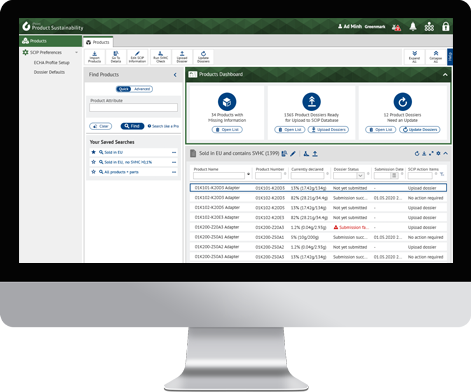


iPoint Product Sustainability – Integrate Carbon Footprints into Your Business
Carbon Footprints in Action
Learn how companies across various industries calculate their carbon footprints and optimize their climate impact.
More Information on CCF
Find out more about CCFs and how you can sustainably reduce greenhouse gas emissions and the climate impact of your company.
Existing standards for calculating a CCF
Two standards have become established worldwide for calculating a corporate carbon footprint:
- GHG Protocol
The GHG Protocol Corporate Standard, shortening for Greenhouse Gas Protocol Corporate Accounting and Reporting Standard was developed by the World Resources Institute (WRI) and the World Business Council for Sustainable Development (WBCSD) in the 1990s. It provides comprehensive guidance for companies to measure and manage their greenhouse gas emissions. It outlines principles and methodologies for both corporate and product life cycle accounting.
- ISO 14064
This international standard specifies principles and requirements for quantifying and reporting greenhouse gas emissions but also for the removal of these emissions. It consists of three parts: Part 1 focuses on organizational-level quantification and reporting, Part 2 covers projects for emission reduction or removal enhancements, and Part 3 provides guidance for validation and verification. Thus, ISO 14064 provides the foundation for developing an effective climate strategy.
While the GHG Protocol offers a broader, more flexible framework popular for voluntary disclosures, ISO 14064 provides a structured, standardized approach suitable for certification and compliance purposes.
What is the Carbon Disclosure Project (CDP)?
The Carbon Disclosure Project (CDP) is a global non-profit organization founded in 2000 in London that helps companies, cities, states, and regions measure and disclose their environmental impact. It provides a comprehensive reporting platform for tracking climate change, water security, and deforestation data. By facilitating transparent reporting and informed decision-making, CDP drives sustainability and encourages organizations to reduce their environmental footprint. Each year, CDP gathers data and information on CO2 emissions, climate risks, and companies' reduction targets and strategies through standardized questionnaires, conducted voluntarily on behalf of investors.
Science-Based Targets Initiative (SBTi)
The Science-Based Targets Initiative (SBTi) is a collaborative effort by CDP, the United Nations Global Compact, World Resources Institute (WRI), and the World Wide Fund for Nature (WWF). It aims to help companies set greenhouse gas reduction targets that are in line with the latest climate science to limit global warming to well below 2°C above pre-industrial levels, with efforts to limit the increase to 1.5°C. SBTi provides a clear pathway for businesses to reduce their emissions through scientifically grounded target-setting, fostering greater corporate climate action and accountability.
What is the Climage Registry (TCR)?
The Climate Registry (TCR) is a non-profit organization that provides standardized reporting and verification of greenhouse gas emissions for businesses, governments, and organizations across North America. Established by by U.S. states and Canadian provinces and territories in 2007, TCR aims to promote consistent and transparent measurement of emissions to support climate action and policy development. It offers a comprehensive system for tracking and managing greenhouse gas data, helping entities set emission reduction goals and enhance their sustainability efforts.
Is the disclosure of carbon emissions data mandatory for companies?
The disclosure of greenhouse gas emissions is becoming mandatory for companies in more and more countries around the world. Currently, this requirement exists in about 40 countries, including the United Kingdom, the United States, Canada, Mexico, Australia, Japan, the European Union, and South Africa. These regulations affect not only domestic companies but often also companies that distribute their products in these countries.
Carbon Accounting in Europe
In Europe, all companies listed on an EU-regulated market and capital market-oriented companies, as well as banks, insurance companies and fund management companies (even if not listed on the stock exchange) with 500 employees or more must report on their greenhouse gas emissions for the first time from 2025 for the 2024 financial year under the European Union's Sustainability Reporting Directive (CSRD).
Implemented by the European Commission in November 2022, the CSRD supersedes and enhances the Non-Financial Reporting Directive (NFRD) by introducing more comprehensive reporting criteria and extending the scope of companies required to adhere to them, including scope 3 value chain emissions.
Climate-Related Disclosure Rules by SEC (US)
The U.S. Securities and Exchange Commission (SEC) has finalized rules, as of March 6, 2024, compelling both domestic and foreign registrants to integrate comprehensive climate-related disclosures into their registration statements and periodic reports. These rules apply to public companies and public offerings.
Streamlined Energy and Carbon Reporting (SECR) in the UK
The Streamlined Energy and Carbon Reporting (SECR) policy, introduced in the UK in April 2019, requires organizations to include data on energy consumption and carbon emissions in their annual reports. The goal is to broaden reporting obligations to a wider range of companies and encourage energy efficiency measures. SECR compliance is mandatory for large enterprises, publicly listed companies, and Limited Liability Partnerships (LLPs).
Discover Other Sustainability Solutions

Calculate the products' climate impact according to ISO 14067, GHG Protocol, or PAS 2050.

Analyze environmental impacts of products across their entire life cycle (ISO 14040/14044).

Measure comprehensive sustainability performance with the EU's PEF methodology.

Prove the environmental performance of your products with an EPD according to ISO 14025.

Support circular economy strategies at every product life cycle stage.
CONTACT OUR CCF EXPERTS
Ready to explore iPoint's CCF Solutions
Contact us to get valuable insights from our experts in Carbon Footprinting and Life Cycle Assessments.


