Product Carbon Footprint (PCF): Definition, Emissions Calculation & Analysis
Product carbon footprint - meaning
The Product Carbon Footprint (PCF) is the most established method for determining the climate impact of a product. Throughout the entire life cycle of a product climate-relevant impacts arise in the form of greenhouse gas emissions. The Product Carbon Footprint helps to identify, analyze and reduce these impacts.
Defining boundaries for accurate PCFs
The most common system boundaries are cradle-to-gate, which measures emissions from raw material extraction to factory gate and is often used for B2B products, and cradle-to-grave, which measures emissions from raw material extraction through manufacture, distribution, use, and disposal, typically for B2C products.
Achieving carbon transparency
A Product Carbon Footprint (PCF) enhances carbon transparency by allowing consumers to make informed eco-friendly decisions, helping businesses optimize production and supply chains, and guiding investors in sustainable investments. This transparency fosters accountability, supports sustainability goals, and can lead to competitive advantages in the market.

Goals & Benefits of Product Carbon Footprinting
Reduction of GHG emissions
Identification of climate-relevant hotspots throughout the entire product life cycle to derive measures for reducing GHG emissions.
Increase competitiveness
Boost market competitiveness by showcasing sustainability efforts and ensuring compliance with environmental regulations and standards.
Enable eco-conscious decision-making
Provide transparent information about a product’s carbon emissions to enable informed decision-making and benchmark performance.
Support carbon offset strategy
Facilitate carbon offset strategies by providing a basis for calculating necessary offsets to achieve carbon neutrality for specific products.
Increasing efficiency
Reveal inefficiencies in production, supply chain, and product usage to optimize processes and reduce carbon emissions.
Driving sustainable innovation
Promote sustainable innovation by encouraging the development of new, low-carbon technologies in product design and manufacturing.

PCF & LCA Made Simple
New to Product Carbon Footprints (PCF) or Life Cycle Assessment (LCA)? Our on-demand webinar is your ideal starting point:
- What PCF & LCA really means and why it's critical to product sustainability
- How academic knowledge translates into industry action
- Key standards and initiatives shaping reliable PCF data exchange






























































































Carbon Footprints in Action - Examples & Applications
Learn how companies from different industries calculate carbon footprints and optimize the climate impact of their products.
More Information on PCFs
Find out more about PCFs and how you can sustainably reduce greenhouse gas emissions and the climate impact of your products.
How to calculate the carbon footprint of a product?
To calculate the carbon footprint of a product, you assess all greenhouse gas emissions across its life cycle — from raw material extraction and production to transport, use, and disposal. This is typically done through a Life Cycle Assessment (LCA). Emission data is collected from process-specific measurements, supplier data, and life cycle inventory databases such as ecoinvent, cm.chemicals, or USLCI. The Global Warming Potential (GWP) of each emission is then applied — usually based on values provided by the IPCC (Intergovernmental Panel on Climate Change) — to express the total impact in CO2 equivalents (CO2e).
This process is often supported by software tools such as Umberto, which help build detailed models of manufacturing, upstream, and downstream activities. This granular approach helps identify specific emission hotspots and reduction opportunities.
How to reduce the product carbon footprint?
Reducing a product's carbon footprint involves optimizing materials, processes, and logistics across the entire life cycle. Key strategies include using low-emission or recycled raw materials, improving energy efficiency in manufacturing, shortening supply chains, switching to renewable energy sources, and designing products for durability and recyclability. Conducting a Life Cycle Assessment (LCA) helps identify the biggest emission hotspots and guides targeted reduction measures.
Existing standards for calculating a PCF
Various standards have been developed to determine the CO2 balance of products. The best-known standards for calculating a carbon footprint are following:
- PAS 2050: Publicly Available Specification (PAS)
First published by the British Standards Institute in 2008 and revised in 2011 to provide an internationally consistent method for quantifying the CO2 balance of products and services
- GHG Protocol: Product Life Cycle Accounting and Reporting Standard
Based on the first PAS 2050 method, published in 2011, contains requirements for quantifying the greenhouse gas inventories of products and for public reporting
- ISO 14067
Most common standard for PCF, consistently being worked , defines the balance limits in which climate change alone is considered an impact category, widely applicable to all products and is intended to promote transparent communication of the results
Differences between the standards
These 3 methods already reach relative consensus in rules for industries or products, recycling and delayed emissions. But there are also significant differences in the standards used to calculate the CO2 footprint. Here are a few examples:
- For instance, the British PAS does not include the following points: Capital goods, human energy input into processes, transport of the consumer to and from the retail location and commuting of employees.
- With the PAS it is possible to neglect 5% of the total emissions, provided that said emissions do not exceed 1% of the total impacts each.
- In the case of GHG, only the 6 substances under the Kyoto Protocol have to be listed in the Life Cycle Impact Assessment (LCIA). The listing of further product-relevant substances is recommended, but is not mandatory.
Product versus corporate carbon footprint
A product carbon footprint (PCF) measures the total greenhouse gas emissions generated throughout a product's lifecycle, from raw material extraction through manufacturing, transportation, usage, and disposal. It focuses on the environmental impact of a specific item.
A corporate carbon footprint (CCF), on the other hand, encompasses the total greenhouse gas emissions produced by a company’s operations. This includes direct emissions from owned or controlled sources (Scope 1), indirect emissions from purchased electricity (Scope 2), and all other indirect emissions from activities like business travel, waste disposal, and supply chain operations (Scope 3).
PCF – More than CO2
The CO2 footprint is not only - as the name suggests - about carbon dioxide emissions, but also about other greenhouse gases. The climate impact of the various greenhouse gases is expressed in CO2 equivalents, since the gases have different global warming potentials.
- Methane (CH4)
- Nitrous oxide (N2O)
- Hydrofluorocarbons (HFCs)
- Perfluorocarbons (PFCs)
- Sulphur hexaflouride (SF6)
- Nitrogen trifluoride (NF3)

Carbon Footprint Consulting Services
Alternatively, our experienced team of experts is at your disposal to calculate the CO2 footprint of your product. We are happy to support you individually step by step, from the collection of data to the complete analysis of climate impacts over the entire life cycle.
Our Carbon Footprint Solutions

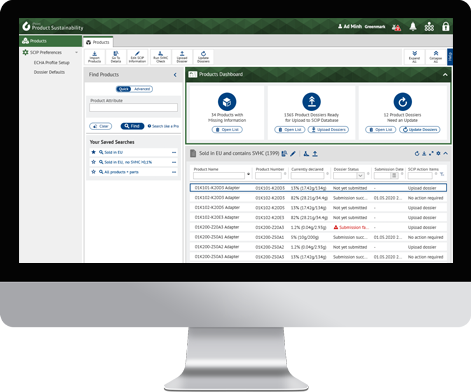


iPoint Product Sustainability – Integrate Carbon Footprints into your business
Other Sustainability Solutions

Calculate your company's carbon footprint in accordance with ISO 14064 and the GHG Protocol.

Analyze environmental impacts of products across their entire life cycle (ISO 14040/14044).

Prove the environmental performance of your products with an EPD according to ISO 14025.

Measure comprehensive sustainability performance with the EU's PEF methodology.

Support circular economy strategies at every product life cycle stage.

Use Compliance and Sustainability Data to design and develop more sustainable products, faster. With…
CONTACT OUR PCF EXPERTS
Ready to explore iPoint's PCF Solutions?
Contact us to get valuable insights from our experts in carbon footprinting and life cycle assessment.


